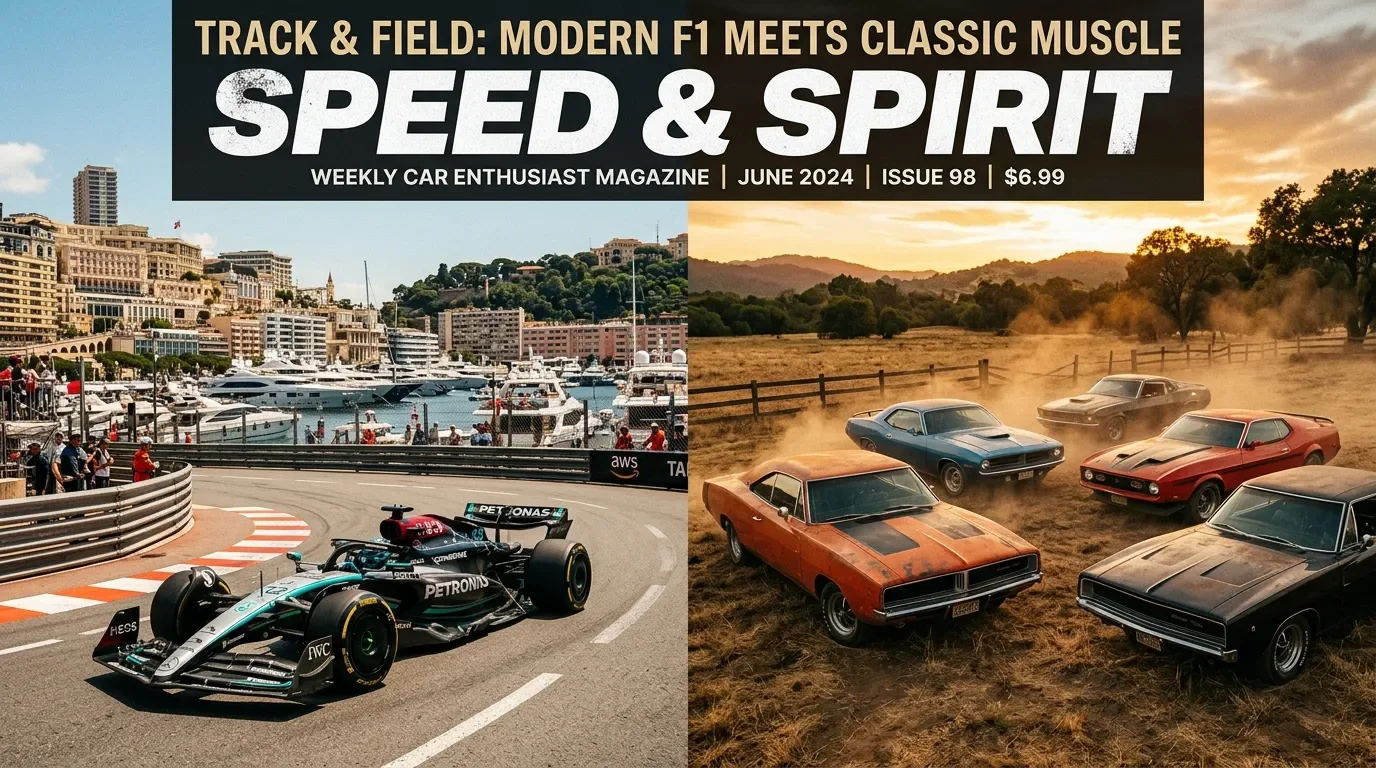
Throttle Weekly — Issue 29: Antonelli Wins Monaco, a Million Jeeps Recalled, and a Field of Chargers Goes to Auction
This week's digest covers Kimi Antonelli's chaotic Monaco GP victory and his growing F1 championship lead, Stellantis's fire-risk recall of 1.08 million Jeep Wranglers and Gladiators, Rivian's new sub-$50K R2 Standard EV, GM's sodium-ion battery announcement, the Dodge Charger's European move, the ongoing UAW strike at American Axle, and a no-reserve auction of 180+ classic Mopar muscle cars in Texas. Plus: a plain-language explainer on EV battery chemistries — what LFP, NMCA, LMR, and sodium-ion actually mean for the buyer.
This Week: Antonelli Does Monaco, a Million Jeeps Recalled, Rivian Gets Affordable, and a Mopar Time Capsule Goes Under the Hammer
The streets of Monaco were chaos. A million Wranglers and Gladiators need to stay outside. Rivian finally has a sub-$50K electric SUV, and somewhere in Texas, rows of vintage Dodge Chargers waited for a hammer drop. Here's everything worth knowing from the week of June 3–10, 2026.
Industry News
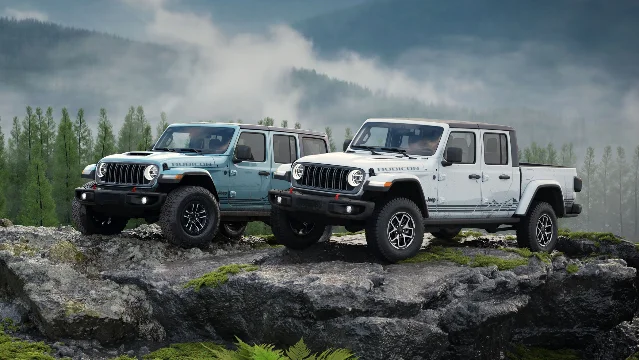
Jeep Recalls 1.08 Million Wranglers and Gladiators Over Fire Risk
If you own a 2021–2025 Wrangler or Gladiator, there's something you need to know: park it outside and away from buildings. Stellantis has recalled 1,076,999 Jeep Wranglers and Gladiators in the U.S. — 1.3 million globally — because the electric hydraulic power steering pump's wiring may overheat and ignite even while the vehicle is parked and turned off. 1
The fault causes high electrical resistance in the wiring circuit, which can build heat until something catches. A "Service Power Steering" message or loss of steering assist may appear beforehand — but there's no guarantee. Stellantis says a fix will be available no later than July; owner notification letters start going out July 9. If you're affected, the NHTSA recalls site goes live for lookups on June 11.
The recall comes on the same day as a smaller but related one covering 17,277 Chrysler Pacifica plug-in hybrids (2020–2022) for a separate battery fire risk. Two fire-risk recalls from the same automaker on the same day is the kind of week Stellantis did not need.
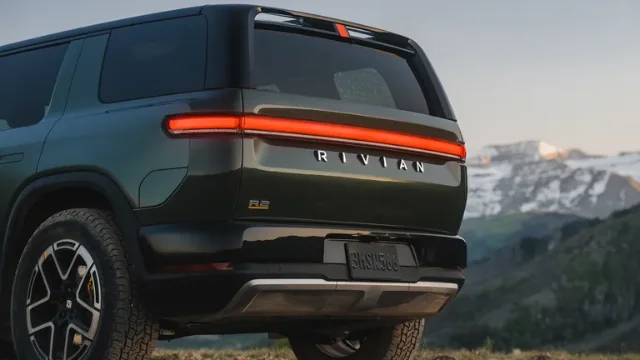
Rivian R2 Standard: $46,235, 275 Miles, Arrives Summer 2027
Rivian has long promised an affordable version of the R2. This week, with Performance Launch Package deliveries beginning at $60,000, the company finally filled in the entry end of the lineup: the 2027 Rivian R2 Standard will start at $46,235 (including destination and delivery) and is expected to deliver an estimated 275 miles of range. 3
The R2 Standard uses a single "Maximus" permanent-magnet rear motor — identical to the $49,985 Standard Long Range — but with a different, smaller battery. Rivian hasn't confirmed the exact pack size, but company sources indicate it will use LFP (Lithium Iron Phosphate) chemistry rather than the NCMA pack in pricier variants. LFP is cheaper to make but less energy-dense, which explains both the $3,750 savings and the 70-mile range penalty versus the Long Range's 345-mile estimate. Both share the same 350-hp output and a 5.9-second 0–60 time.
Rivian says more details will come closer to the R2 Standard's planned summer 2027 launch, with the Standard Long Range arriving in spring 2027 first. At $46K the R2 Standard enters a tightening segment: Tesla's cheapest Model Y now starts at $41,630 with 321 miles.
GM Bets on Sodium-Ion Batteries — Not for Your EV, But Still Matters
General Motors announced on June 9 that it is developing sodium-ion battery cells in partnership with a startup called Peak Energy, adding a fourth battery chemistry to its portfolio alongside NMCA, LFP, and the upcoming LMR cells. 4
The catch: these sodium cells aren't headed for your Equinox EV. For now, GM plans to use them for large-scale stationary energy storage systems — the giant battery banks that power data centers and electrical grids. Sodium has genuine advantages here: it's cheap, abundant, free from Chinese supply-chain dependence (unlike lithium), handles extreme temperatures without liquid cooling, and promises lower lifetime costs than LFP over a 20–25 year system lifespan.
Why should EV buyers care? GM's VP of battery and sustainability Kurt Kelty (formerly Tesla's battery chief from 2006–2017) argues the commercial sodium push will accelerate the company's overall battery R&D pace, including faster progress on LMR cells — the high-priority chemistry designed to dramatically lower the cost of large EV pickups and SUVs. The company's newly opened Battery Cell Development Center in Warren, Michigan is designed to shorten the path from lab chemistry to production by up to a year. LMR volume production is still targeted for 2028.
Kelty was direct: GM will not put sodium-ion cells into EVs in the short or medium term — the energy density is too low. But the global EV transition is only getting started, and the company wants chemistry options that don't run through Chinese processing facilities.
Dodge Takes the Charger to Europe — Sales at Home Are Struggling
With both the Charger Sixpack (twin-turbo inline-six) and Charger Daytona EV selling poorly in the U.S., Dodge announced on June 8 that it will export the entire Charger lineup to Europe, handled by importer KW Automotive and their dealer network. 5
The numbers behind the move are stark. Dodge moved just 240 Charger Daytona EVs in the first quarter of 2026, down from 7,421 units in all of 2025. The Sixpack, which only hit showrooms a few months ago, sold 1,672 units in Q1 — a far cry from the tens of thousands the old Charger moved each quarter. No timeline has been confirmed for European deliveries, and the cars will need regulatory modifications to meet EU standards. Whether European buyers respond differently to a loud American muscle car remains to be seen.
UAW Strike at American Axle Enters Second Week, GM Plants Still Running
The UAW strike at American Axle's Three Rivers, Michigan plant — which began June 1 — stretched into its second week with no resolution announced. Roughly 1,000 workers walked out demanding higher wages after years of concessions; the plant produces axles for GM's Silverado and Sierra pickup trucks. 6
As of June 9, GM said none of its assembly plants had been directly affected — the automaker had reportedly stockpiled roughly two weeks' worth of axles before the strike began, and deliveries from the struck plant were still reaching GM's Flint Assembly facility via truck. 2 With that buffer likely depleted or near exhaustion around mid-June, the pressure on both sides is mounting. The UAW's 39th Constitutional Convention opens June 15 in Detroit — timing that gives the union leadership additional political context for any deal.
On the Circuits
Antonelli Wins a Chaotic Monaco Grand Prix, Extends Championship Lead
Kimi Antonelli became the youngest winner of the Monaco Grand Prix on Sunday, June 7, claiming his fifth consecutive victory of the 2026 Formula 1 season for Mercedes in a race that saw seven drivers fail to finish. 7
The Italian started from pole and led from lights to flag, but the race itself was anything but clean. Max Verstappen was eliminated at the start when his Red Bull went into anti-stall. Lando Norris retired from power issues. Lance Stroll and then local favourite Charles Leclerc crashed into the same wall at the Antony Noghes corner in the closing laps, causing a red flag for track surface inspection. The safety car, the red flag, pit lane speeding penalties, and a standing restart turned the points order into a bureaucratic puzzle that wasn't fully resolved until well after the chequered flag.
When the dust settled: Antonelli 1st, Lewis Hamilton 2nd, Isack Hadjar 3rd. George Russell, who took two penalties for pit lane speeding and then received a drive-through for failing to serve his original punishment, wound up 11th. Oscar Piastri finished 4th as McLaren's sole finisher.
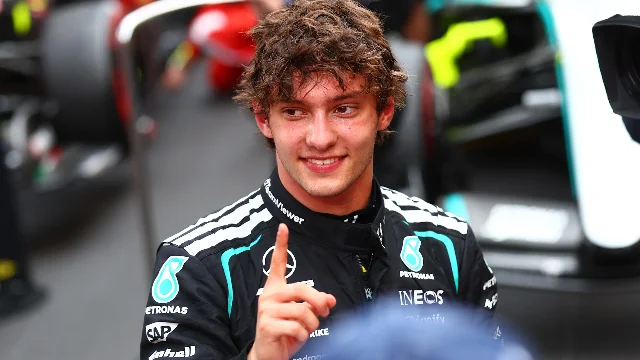
Antonelli now leads the Drivers' Championship standings with a widening margin. The season continues next weekend at the Barcelona-Catalunya Grand Prix (June 12–14).
Quick note for Fernando Alonso fans: the Spaniard salvaged Aston Martin's first top-10 finish of the season, thanks to a cascade of penalties dropping other cars behind him.
How It Works: What Are Battery Chemistries, and Why Does It Matter Which One Powers Your EV?
This week's GM announcement introduced a fourth battery chemistry into the conversation — sodium-ion — right alongside LFP, NMCA, and the forthcoming LMR. If you've noticed automakers talking more and more about battery chemistry lately, there's a practical reason: the chemistry inside your EV pack determines range, longevity, charge speed, cold-weather performance, cost, and supply-chain exposure. Here's what each term actually means.
NMC / NMCA (Nickel Manganese Cobalt [Aluminum]) is the chemistry in most premium EVs today, including GM's Cadillac, Chevrolet, and GMC electric models. High energy density — meaning more miles per pound of battery — is its main advantage. The tradeoff is cost (cobalt is expensive) and thermal sensitivity (the cells need active liquid cooling).
LFP (Lithium Iron Phosphate) sacrifices about 20–30% energy density compared to NMC but compensates with lower cost, better thermal stability, longer cycle life (you can charge it to 100% regularly without damaging it), and no cobalt. It's the dominant chemistry in Chinese EVs and is now used in the 2027 Chevrolet Bolt, Tesla's standard-range models, and Rivian's base R2.
LMR (Lithium Manganese Rich) is the chemistry GM is racing to commercialize for volume production by 2028. The pitch: energy density close to NMCA at cost closer to LFP — the combination that could finally make large electric trucks and SUVs competitively priced. Manganese is abundant and cheap.
Sodium-ion replaces lithium with sodium, which is even cheaper and more widely available. The downside is lower energy density still, which rules it out for compact EVs where every kilogram matters. But for a stationary battery sitting in a warehouse or on a power grid, energy density matters less than cost, lifespan, and the ability to operate without cooling systems. That's the target GM and Peak Energy have in mind.
The practical takeaway: when you see a sub-$40,000 EV advertised in 2027 or 2028, the battery chemistry is likely a large part of why that price is possible.
Barn Find of the Year
180+ Classic Mopars Go to No-Reserve Auction in Texas
Every barn find story has the same setup: somebody discovers a field of forgotten cars, the internet gets excited, and then half the vehicles turn out to be scrap. The Houston Mopar Meltdown and the Alabama Barn Find Absolute Auction, held June 6 in Walnut Springs, Texas, was a different kind of event — more than 180 vehicles with no reserve on any lot. 8
GMTV founder John Clay Wolfe spent months cataloging two separate collections: one in Houston, one in Talladega, Alabama. The Houston portion was essentially a Mopar archive — roughly 70 vintage Dodge Charger project cars and bodies, factory 440 engines, Super Bee projects, carburetors, rear ends, intake manifolds, and enough loose parts to fill shipping containers. The Alabama collection added Corvettes, an Oldsmobile 442, a Buick Boat-Tail Riviera, vintage Cadillacs, Mustangs, and a 1971 Dodge Demon nicknamed "Demonic" — a custom build that had previously been featured on the cover of Mopar Magazine, which Wolfe estimated could represent a six-figure restoration on its own.
The no-reserve format meant every single lot sold regardless of bid price, which created real tension. "This is risky business putting all this up for auction without a safety net," Wolfe said before the event. "But the response from the public and the car community has been so overwhelming that we wanted to open the doors completely." 8
Wolfe described arriving at the Houston property to find vehicles buried so tightly together that there was barely room to maneuver — and, he claimed, roughly 10,000 snakes. His team ultimately relocated dozens of cars to a staging yard in Brookshire, Texas before cataloging them for sale. Whether the auction produced bargain steals or unexpectedly strong prices for the sellers, it represented one of the more unusual collector-car events of the year.
Next issue: Barcelona-Catalunya GP results, and we'll follow up on whether GM's Flint Assembly line stays running as the American Axle strike buffer runs dry.
참고 출처
- 1Car and Driver — Jeep Recalls 1 Million Wranglers and Gladiators
- 2The Drive — Downshift June 9 2026
- 3Motor Trend — 2027 Rivian R2 Standard Starts at $46,235
- 4Car and Driver — GM to Develop Sodium-Ion Battery Cells
- 5Car and Driver — Dodge Charger Coming to Europe
- 6Fastmarkets — Automotive Steel Demand at Risk in UAW Strike
- 7Formula 1 Official — Monaco Grand Prix Race Report
- 8AOL / Guessing Headlights — Barn Find Bliss: 180+ Classic Muscle Cars
이 콘텐츠를 둘러싼 관점이나 맥락을 계속 보강해 보세요.