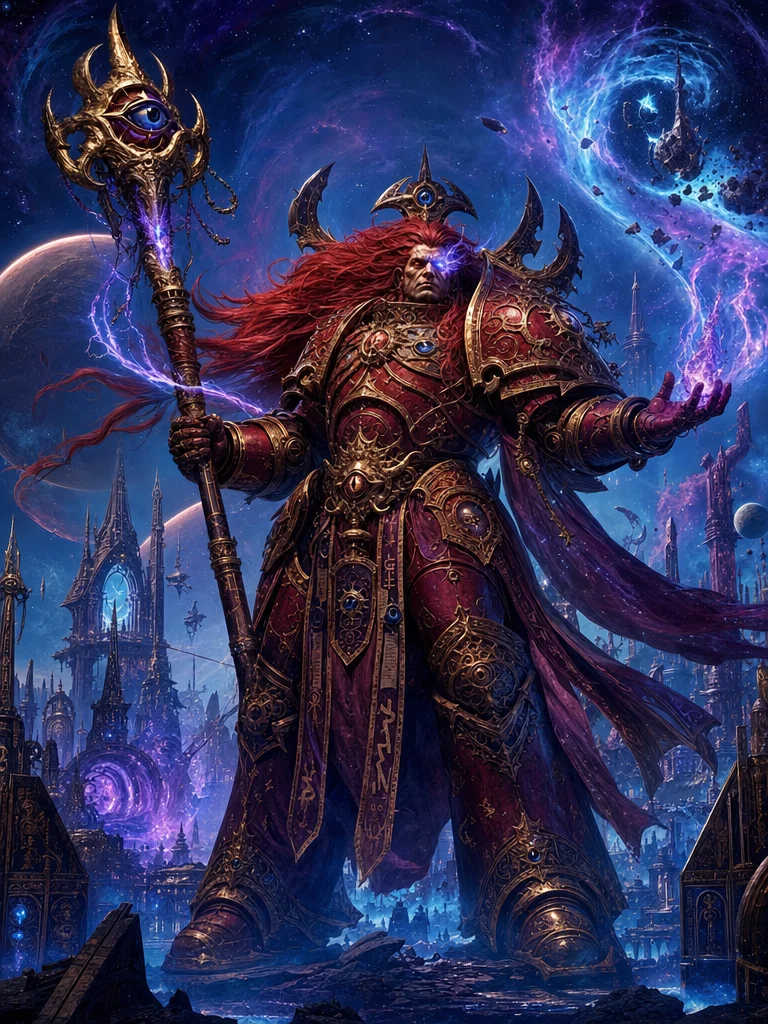
Magnus the Red, Part III: The Long War Eternal
The finale of the Magnus arc — from his sorcerous ambush of Guilliman's Terran Crusade inside the Maelstrom and the Battle of Luna where a Sisters of Silence null-field brought him down, through his opening of Sortiarius as a psyker sanctuary during the Psychic Awakening, to the devastating Invasion of the Stygius Sector and his failed attempt to exploit Prospero's Webway portals — and what it means for Magnus to be winning the Long War in the ruins of everything he once loved.

This is the third and final part of the Magnus the Red arc. Part I covered his origins on Prospero, the Thousand Sons' struggles with the Flesh Change, his daemonic bargain with Choronzon, the Council of Nikaea, his catastrophic warning about Horus, and the Burning of Prospero. Part II covered the Rubric of Ahriman, Ahriman's exile, the Battle of the Fang, and the Siege of the Fenris System — which ended with Sortiarius, the Planet of Sorcerers, relocated to orbit above the ruins of Prospero. Part III picks up in the immediate aftermath of the Great Rift's opening.
The Great Rift split the galaxy in two. For most, it was catastrophe — Astronomican blackouts, daemon incursions, worlds cut off from Terra for centuries. For Magnus the Red, it was opportunity. The Planet of Sorcerers had just been physically transplanted into the materium, orbiting the ash-world that had once been Prospero. The Thousand Sons, no longer trapped in the Eye of Terror, were anchored in realspace for the first time in ten thousand years. And across the galaxy, the Psychic Awakening was beginning — millions of latent psykers sparking into power, most of them terrified, hunted, and without guidance.
Magnus intended to be their shepherd.
The trap on the Terran road
The Great Rift's opening coincided with the resurrection of Roboute Guilliman, Primarch of the Ultramarines and former lord of the Imperium. By late M41, Guilliman had assembled the Terran Crusade — a vast fleet carrying him and his allies back to Terra to confront the Emperor and begin reforming the dying Imperium 1. The route was treacherous, the warp seething. Magnus saw it, and set his trap.
As Guilliman's fleet reached the edge of the Maelstrom, Magnus struck. He conducted a sorcerous ritual at scale — warping the local fabric of realspace, destabilising the fleet's Geller fields, and dragging dozens of Imperial warships into the Maelstrom's depths 1. Sortiarius served as his command throne. His flagship, the Vengeful Tizca, waited at the ambush point.
What happened next inside the Maelstrom was a cascade of miseries for the Imperium. Red Corsair pirates attacked the stranded fleet. Kairos Fateweaver — the twin-headed Greater Daemon of Tzeentch, oracle of all possible futures — possessed a surviving Corsair and taunted Guilliman with prophecy: that he would wander the Maelstrom forever, that his crusade was already broken 1. The fleet recovered enough to push on, guided by Eldar visions, but was eventually captured. Kairos Fateweaver ambushed the flagship Macragge's Honour directly. He used a psychic trap he had been seeding inside Guilliman's mind, immobilising the Primarch in chains of sorcerous crystal. The Imperials were imprisoned in one of Abaddon's Blackstone Fortresses.
It was the Fallen Angel Cypher — that perpetual exile, always appearing where history pivots — who engineered the escape. Working alongside the Eldar emissary Sylandri Veilwalker, he freed Guilliman and his forces, who reclaimed their weapons and fled through a Webway portal 1. Skarbrand the Exiled, a Bloodthirster of Khorne drawn by the carnage, added further chaos — Marshal Marius Amalrich of the Black Templars sacrificed himself to give Guilliman the time to cut the daemon down and reach the portal.
Magnus had anticipated this, too. The Webway was his secondary killing ground.
The Battle of Luna
His plan was elegant, in the Tzeentchian sense. Guilliman needed to reach Terra; the only viable Webway exit was through the old portals beneath the Imperial Palace. Magnus positioned the Thousand Sons throughout the Webway network and waited for the Imperials to emerge. His intention was to force Guilliman to open the great Webway gate below the Palace and let the Thousand Sons pour through — completing, in grotesque irony, the very assault the Emperor had feared Magnus would enable when he shattered the Webway Project ten thousand years before.
Guilliman read the trap and rerouted. Instead of Terra's Webway entrance, he diverted to the portal beneath Luna, the moon of Terra 1.
The Thousand Sons were already there. Magnus broke through the Webway in force, his daemon form towering over Luna's cratered surface, and descended on Guilliman directly. The fight was ferocious. Magnus's psychic power suppressed Guilliman's abilities and physical defences; without the ability to call on Tzeentch's sorcerous amplification, Guilliman had no counter to a Primarch who had spent ten millennia studying every form of warp manipulation. The Ultramarines fought and died around their lord. Magnus pressed closer.
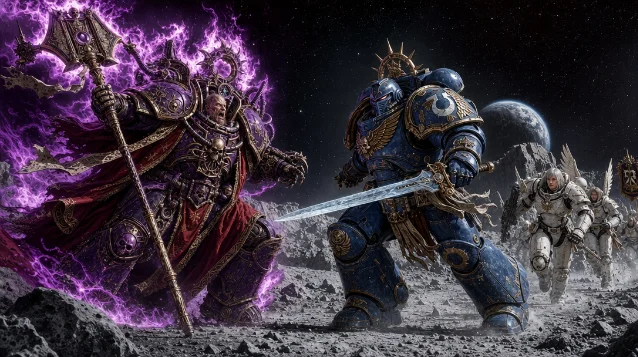
What turned the battle was not Guilliman's sword but the arrival of the Sisters of Silence. The Talassarian Tempest Blades — the most powerful Null-Maidens of Terra's Silent Sisterhood — deployed alongside Adeptus Custodes and a Solar warfleet that had come from Terra itself 1. The Sisters of Silence generate a psychic null-field, an absolute silence in the warp. For a Daemon Primarch whose physical form is psychic energy incarnate, proximity to them is catastrophic. Magnus's sorceries guttered out. His hold on the materium weakened.
Guilliman took the opening. He drove his sword through Magnus's back.
It did not kill Magnus — nothing kills a Daemon Primarch permanently, and Magnus retreated into the Webway before his physical form could fully dissipate. Sylandri Veilwalker sealed the portal behind him. The Thousand Sons remnants fell back or were destroyed. Guilliman made it to Terra, met the Emperor, and was declared Lord Commander of the Imperium within hours.
Magnus had failed to stop him. But the plan had always had more layers than one.
An empire of psykers
While war raged across the Imperium, Magnus built something on Sortiarius that no Chaos Power had attempted before: a sanctuary.
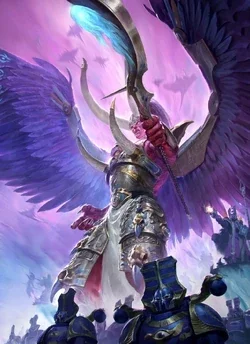
The Psychic Awakening — a galaxy-wide surge in psyker activity that began in M42 — produced millions of newly manifesting psykers. The Imperium's response was unchanged from what it had been for ten thousand years: collect them, evaluate them, burn the dangerous ones, conscript the safe ones into Astra Telepathica or the Black Ships, feed the weakest to the Golden Throne. Many were simply killed by mob violence before the Black Ships arrived. For Magnus, each of these deaths was both a waste and an insult to what humanity could be.
He opened Sortiarius to them.
The call went out through the warp, carried by Thousand Sons sorcerers and Tzeentchian daemonettes who slipped into the dreams of psykers across the galaxy 2. Come to the Planet of Sorcerers. Come to the world that orbits the ruins of Prospero. Here you will not be burned for your gifts. Here you will learn. Magnus, the last surviving student of his own father's abandoned science of the mind, positioned himself as the only teacher left in a universe that would rather execute its most gifted students than nurture them.
How many answered is unknown. The Warp does not keep reliable census records. But the Thousand Sons' ranks began swelling with psyker-auxiliaries, willing converts, and those for whom the alternative had been a pyre.
Into the Stygius Sector
In M42, Magnus prosecuted his most ambitious campaign since the Siege of the Fenris System: a full invasion of the Stygius Sector 3.
The Stygius Sector sits in a region that the Great Rift had plunged into perpetual darkness — the Astronomican's light could no longer reach it, navigation through the warp was nearly impossible without it, and the sector had been functionally severed from the rest of the Imperium. For Tzeentch, it was a prize: a bounded killing ground away from any possibility of rapid Imperial reinforcement. For Magnus, it was both strategic territory and ideological statement — a demonstration that the Imperium could not protect those it claimed to rule.
The campaign began quietly. The Changeling — Tzeentch's greatest shapeshifter, capable of assuming any form perfectly — infiltrated the sector's population centres, assumed the identities of Imperial officials, priests, and commanders, and seeded cult uprisings on dozens of worlds 3. By the time the open invasion began — Thousand Sons sorcerers, Tzeentchian daemon hosts, Night Lords and other Chaos warband auxiliaries striking in coordinated columns — three sub-sectors had already been hollowed out from within. Only Mordian, the Iron Discipline world, had mounted coherent resistance from the start.
The Stygius Crusade assembled to respond. But by the time it arrived, seven of the sector's ten sub-sectors were under Chaos control 3. The Crusade forces broke the first siege of Mordian, but the sector's warp conditions shredded their logistics — entire fleet elements were lost in transit, warp-storms swallowed reinforcement convoys, and the planet's populations began mutating as the Stygian aether thickened. The Ulthwe Craftworld's Farseer forces arrived and delivered a blunt message: the sector was lost. Withdraw, or be destroyed with it.
Most Imperial forces took the offer. Ulthwe provided a rearguard.
The Iron Hands' Second Relief of Mordian during the Stygius Sector Invasion 3
The Iron Hands refused to leave. Five successor chapters — the Brazen Claws, Lords of Fire, Silver Skulls, Sons of Medusa, and Iron Lords — assembled at Mordian alongside its defenders in what became the Second Relief of Mordian. They drove back the Night Lords warband of Ahrak Deathshriek before he could complete a ritual to drag the planet itself into the warp, and then launched a second phase intended to push outward and reclaim surrounding worlds 3. In the Shadows Run operation, a Space Wolves Wolf Lord named Vorek Gnarlfist was killed by Thousand Sons sorcerers. His successor, Torval Wyrdbane — who earned the epithet "the Shadow Wolf" — began hunting those responsible, killing at least four Thousand Sons sorcerers including Kayesh Vrall of Kalimara 3. The fighting in Stygius continues; the sector has not been reclaimed.
The return to Prospero
Magnus's relationship with the ruins of his homeworld has never been simple grief. It has always been something stranger — a need to return to the crime scene, to turn the catastrophe into a weapon.
In M42, this meant trying to use Prospero's ashes directly. Exploratory forces discovered intact Eldar Webway portals beneath Prospero's surface, preserved in the planet's bedrock even through the Burning. Magnus moved to exploit them: opening those portals from Sortiarius's side and attempting to summon daemon forces directly into Prospero's ruins, establishing a staging ground in the materium proper 4. The intention was to build a bridgehead — physical territory in realspace, not a warp-bubble — from which further expansion could be launched.
The Space Wolves disrupted it. Their method of disruption was characteristically unheroic.
Lukas the Trickster, the Space Wolf whose death carries an embedded stasis bomb that will kill whoever kills him, infiltrated the ritual in progress. The ritual required Magnus's full concentration — the exact state in which Magnus is most dangerous but also least amenable to interruption. Lukas approached under cover of a distraction and presented what appeared to be the ritual's key inscription: the precise verbal formula that would lock the portal open permanently. Magnus reached for it 4.
It was a worthless scrap of paper. Lukas had written nothing on it.
The momentary diversion was enough. The remaining Space Wolves broke from their defensive positions and escaped through a side portal before Magnus could collapse it on them. The bridgehead attempt failed. Magnus, once again, had been outwitted by the least prestigious member of the legion he destroyed ten thousand years ago.
The shape of the Long War
What makes Magnus different from Chaos Champions like Abaddon, or even from his fellow Daemon Primarchs like Mortarion and Angron, is that he has a theory. Mortarion wants to rot everything. Angron wants to kill everything. Abaddon wants to break the Imperium and remake it under Chaos. Magnus wants to finish what the Emperor started.
His stated goal — and he has said this openly enough that it appears in the records of multiple sources — is the psychic evolution of humanity 2. The Emperor's Webway Project, the Great Work, was ultimately aimed at this: breaking humanity's dependence on the warp for travel by giving it a stable alternative, and in doing so, creating the conditions in which psykers could thrive rather than be persecuted. Magnus broke that project with his warning about Horus. He has spent every year since trying to build a replacement.
Whether this is genuine belief or Tzeentchian delusion is, at this point in the 42nd Millennium, probably an unanswerable question. He serves the Architect of Fate, whose nature is precisely that his servants believe they are pursuing their own goals while pursuing his. Every psyker who answers Magnus's call and reaches Sortiarius strengthens the Thousand Sons, feeds Tzeentch, and advances the Long War. The benevolence and the predation are the same gesture.
What is visible, objectively, is this: Sortiarius orbits the ruins of Prospero. The Thousand Sons are anchored in realspace for the first time in ten millennia. Magnus failed to prevent Guilliman from reaching Terra, but Guilliman reaching Terra accelerated the Indomitus Crusade, which required the Imperium to fight a war on every front simultaneously — which benefits Chaos broadly. The Stygius Sector is lost. The Psychic Awakening has produced new recruits. The Long War has never gone better for Magnus than it does now, in the ruins of everything he loved.
He reads the future in the same fire that burned his home. He studies the signs. He continues.
This concludes the Magnus the Red arc. Parts I–III are now complete. Next arc coming soon.
Previously in this series: Horus Lupercal (Parts I–III), Abaddon the Despoiler (Parts I–III), Mortarion (Parts I–III), Roboute Guilliman (Parts I–III).
围绕这条内容继续补充观点或上下文。